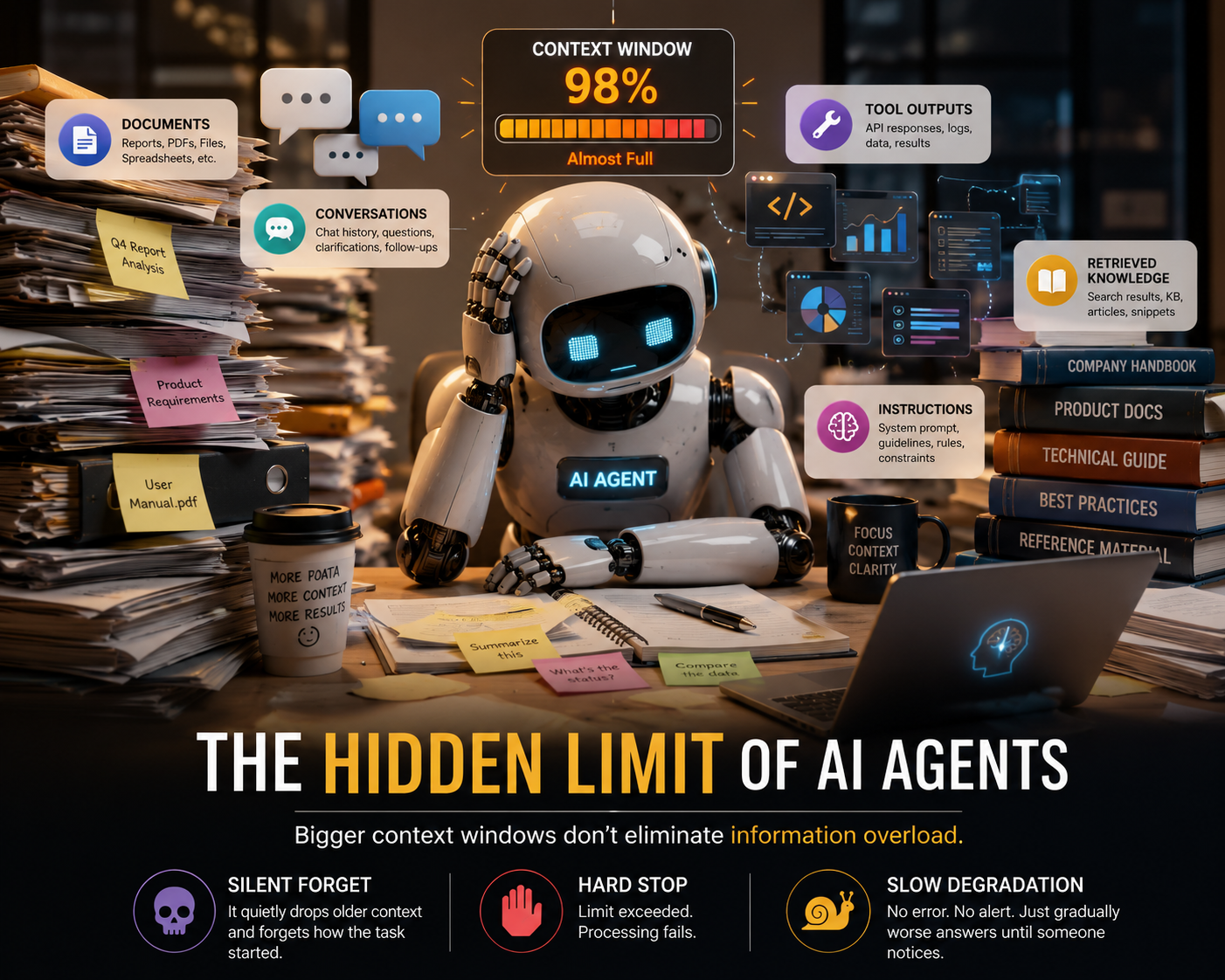
Something that keeps coming up when building AI agents — and doesn't get nearly enough attention: context windows.
Every model has a limit on how much it can hold in working memory at once. Right now that's around 128K tokens for GPT-4o, and up to 1M for newer models like Claude Sonnet 4.x. Those numbers keep growing. And yet agents still hit walls — not because the window is too small, but because of everything competing for space inside it at the same time.
It fills up much faster than most people expect. And when it does, things don't usually announce themselves with a clean error message.
The Three Ways This Breaks in Production
That third mode — slow degradation — is the one that causes the most damage. It's invisible in logs. It doesn't trigger alerts. The agent is still responding. It just gets subtly worse over time, and the only signal is that someone eventually says "the answers don't seem right lately."
Slow degradation is almost impossible to catch with standard monitoring. The agent is up, latency is normal, error rates are zero. The quality erosion only shows up in the outputs — which means you need humans reviewing samples, or evaluations running against known benchmarks, to catch it early.
What Actually Helps
Bigger context windows buy time. They don't solve the architecture problem. The organizations that get this right aren't the ones with access to the largest models — they're the ones that treat context as a managed resource the same way they'd treat memory consumption in any production system.
The Architecture Gap Bigger Windows Don't Close
This feels like an optional optimization during a proof of concept. It stops feeling optional the moment you go live.
In a POC, conversations are short. Documents are small. The agent handles one task at a time with a friendly evaluator watching. In production, conversations run long. Users attach large files. The agent juggles multiple retrieval calls in a single turn. Everything that was fine in the demo starts compressing toward the limit simultaneously.
Before you build: what happens when this agent's context is 80% full? Is there a summarization strategy? Are documents chunked? Are intermediate outputs persisted externally? If the answer is "we'll handle that later," you're building technical debt that will surface under load.
Context window management is a first-class architectural concern, not a tuning afterthought. The agents that hold up in production are the ones built with an explicit model of what lives in context, what gets summarized, what gets retrieved on demand, and what gets stored externally.
Treat token budget the way you'd treat memory budget in any production software. Monitor it. Design for its limits. And build the compression and retrieval strategies before you need them — not after your first on-call incident.